Engaging in night flying necessitates a shift in routine, requiring pilots to rest during daylight hours and operate under the cover of darkness. While the fundamental processes of takeoff, flight, and landing remain unchanged, the experience of flying at night presents unique challenges compared to daytime operations.
During the day, pilots can fly in formations of two, four, or even six aircraft. But at night, flights are usually conducted solo, moving cautiously one by one. Daytime pilots can see each other with the naked eye, fly in tight formations – wing to wing – and perform complex aerobatic maneuvers together. But at night, that’s impossible. Night flight formations must maintain distances of hundreds or even thousands of meters between aircraft. In reality, night combat missions are rarely flown in formations – almost all are solo flights.
In daylight, pilots can fly at extremely low altitudes, a technique jokingly called “crab hunting” by aviators – flying just meters above the terrain, using ground features for navigation, and finding their way back to the airfield visually. But at night, such low-altitude flying is impossible. Navigating the dark sky is already complex, and takeoff and landing at night are even more challenging.
Despite the many difficulties and risks, night flying sometimes offers breathtakingly poetic moments that daytime flights could never provide. Pilots taking off just as the full moon rises witness an enchanting sight – a gentle, radiant moon, like a massive jade disc, casting its soft, serene glow. The sky becomes a vast, velvet tapestry adorned with countless sparkling diamond-like stars.
On moonless, starless nights, however, the sky turns bleak and lifeless, especially during covert missions when radio communication must be minimized. The boundless, dark sky makes a pilot feel incredibly small and alone. In that darkness, countless dangers and unseen threats lurk. Sitting alone in the cockpit, bathed in the dim red glow of instrument panels and switches, with only the hum of the engine fading into the endless void, one suddenly feels an overwhelming solitude.
When the weather turns, storm clouds surge, lightning flashes wildly, and the sky seems to shatter into countless fragmented pieces. One moment, the light is blinding; the next, darkness engulfs everything. The aircraft is tossed in multiple directions by violent turbulence. Yet, despite these dangers, night-flying pilots must face them head-on to complete their missions.
(Colonel Nguyen Cong Huy, MiG-21 pilot,
Former Deputy Division Commander, Chief of Staff of Air Division 371
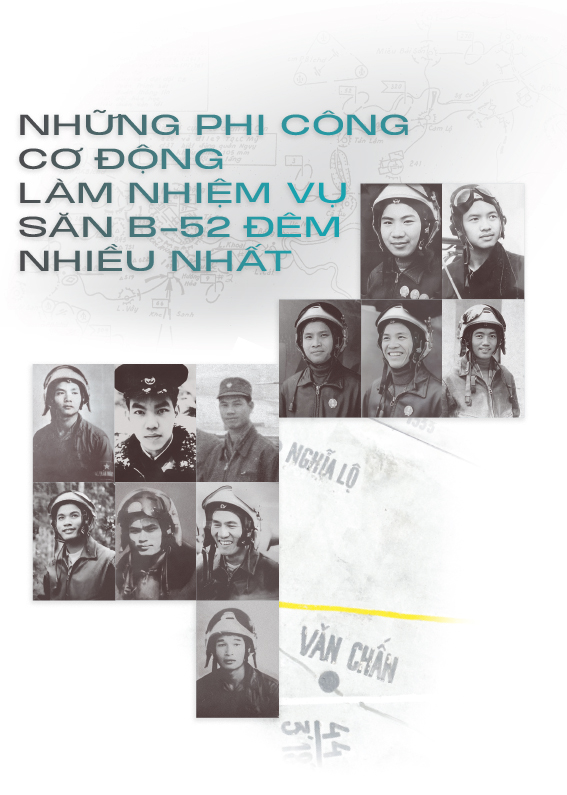
The Most Prolific Nighttime B-52 Killers
Lâm Văn Lích, Mai Đức Toại, Nguyễn Đăng Kính, Vũ Đình Rạng, Hoàng Biểu, Đặng Xây,Trần Cung và Vũ Xuân Thiều, Phạm Tuân, Nguyễn Đức Chiến, Bùi Doãn Độ, Nguyễn Khánh Duy,…
. . .
